The following words were produced by a human.
Urine mining is a new market category being created by Wasted. After six years of trying to figure out if we are (1) a porta-potty company or (2) a regenerative fertilizer company, we’ve de-risked and evolved into something that now feels… right.
The truth is that it is incredibly difficult to build a new market category – especially if it smells – and even more so if it has anything to do with human waste.
Urine mining is the collection of human pee with the intention of processing and recovering useful nutrients into fertilizers. At Wasted, it’s the foundation of the company we’re building. Human urine contains nitrogen, phosphorus, and potassium — the nutrients plants need to grow. Those nutrients pass through our bodies, and our sanitation systems determine where they go next.
From our point of view, urine is one of the most undervalued recurring resources on Earth. Every day, we produce something with practical value. Humans also spend considerable effort collecting, transporting, and treating it as waste. There is an opportunity to design that system around recovering what’s useful.
That’s why we describe Wasted* as a urine mining company.
The word “mining” is intentional. It asks us to recognize a resource, build the infrastructure to collect it, and turn it into something people can use. Calling urine valuable is the easy part (kind of, once you think about it a bit). Building a system that makes use of that value is the work. And it starts at the toilet level.
Imagine you’re taking a dog on a walk, she pees here, walks a few feet, then poops there. This is called source separation. For humans, urine leaves our bodies separately from solid waste – once again, source separation. Wasted toilet ecosystems are biomimetic; meaning we are copying the design of Nature. By keeping those streams separate at the point of collection, we can preserve the integrity of urine for treatment and nutrient recovery, which then allows us to manufacture the highest potential fertilizers.
And that’s why the bathroom experience matters so much to us.
A person walking into a toilet is thinking about cleanliness, privacy, comfort, and whether or not everything works. A construction superintendent is thinking about service, cost, and keeping a jobsite running. Those expectations have to shape the system from the beginning.
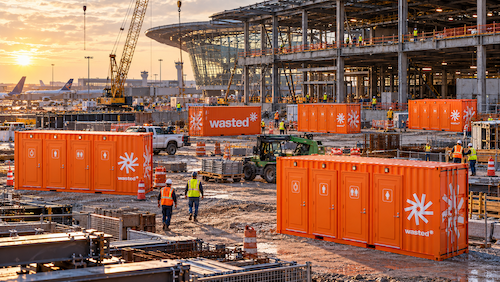
We’ve developed the Wasted*Can with those needs in mind: a waterless restroom built inside a shipping container, using urine-diverting conveyor toilets to separate the streams at the source.
For us, the Can is both a restroom and a collection point. Its usefulness as resource-recovery infrastructure depends on how well it serves the people using and managing it.
Construction is where we’re focusing this next chapter. Jobsites already bring groups of people together in places that need temporary sanitation. They already purchase a service to manage what those people leave behind. We see an opportunity to improve that service, save our customers money, and build a reliable way to collect urine.
Our ambition is to build a network that connects those pieces: toilets that separate, services that collect, facilities that process, and customers who use the recovered nutrients. We’ll need to earn that scale through systems that work in practice. And the starting point is providing Cans for jobsites.
What excites me is the possibility of changing people’s relationship with something they produce every day. A bathroom can become a place where people participate in something so much bigger than any one person, just by going pee.
So, the next time someone asks “What is Wasted?” Friends, family, investors, colleagues, and most importantly, those who use our toilets can reply: “The Urine Mining Company.”
Note: Special shoutout to the authors of “Play Bigger” – their frameworks, storytelling, and shared language were pivotal in guiding my team to develop our category.
Curious about the collection point? Meet the Wasted*Can and explore what it could look like on your jobsite.
Written by: Thor Retzlaff, Co-Founder